Is there a connection between April Fools’ Day and the Tarot’s Fool card? Tarot expert Auntie Verona Moon investigates the history.
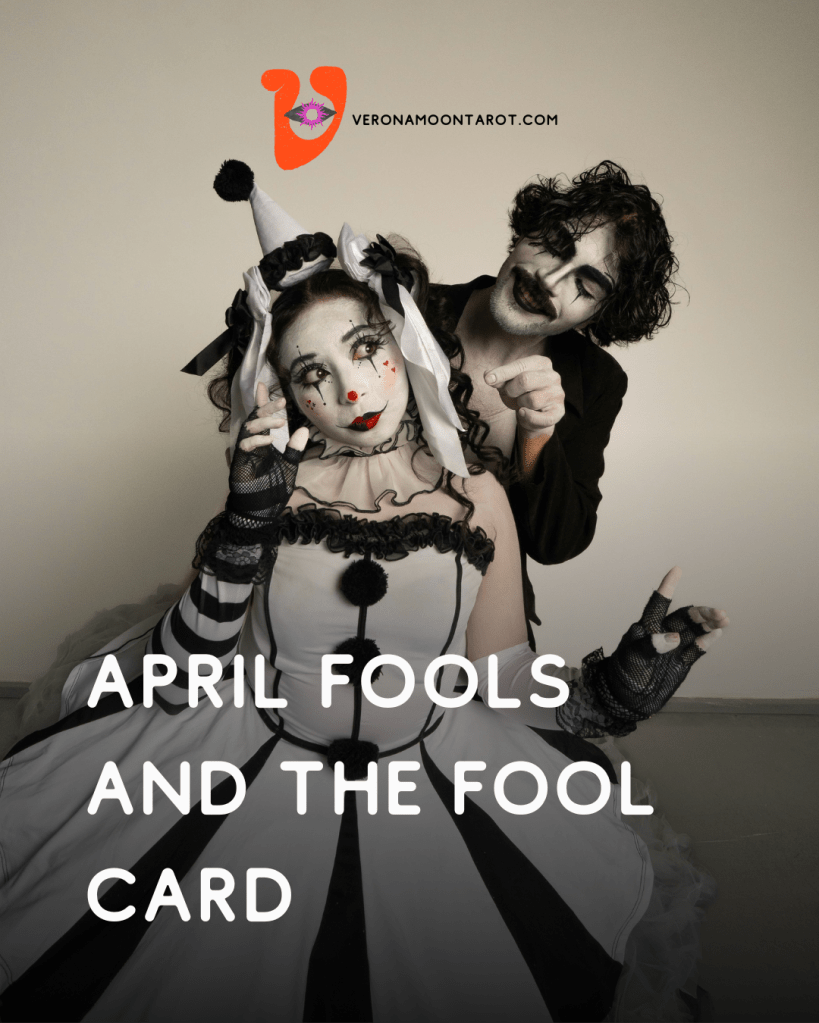
I was doing an Ostara spread the other day — connecting it to the Fool card, factoring in new beginnings and planted seeds and that big first leap of faith — when it occurred to me that April Fools’ Day was just around the corner.
And I had to wonder: with The Fool card so tied to spring, is there a historical connection between the two?
Darling, I went down the rabbit hole so you don’t have to.
Where Did April Fools Actually Come From?
The short answer is: nobody is entirely sure. Which feels very appropriate for a day built around deception.
The most popular theory traces it back to 16th century France, when the country switched from the Julian calendar to the Gregorian calendar — moving the new year from the Spring Equinox (which falls close to April 1st) to January. Those who were slow to hear the news and kept celebrating in the spring became the targets of pranks and jokes. History.com notes this is the leading theory, though historians debate whether it tells the whole story.
Go back even further, and you find spring festivals across many ancient cultures that featured trickery as a feature, not a bug. The Romans celebrated Hilaria — Latin for “joyful” — at the end of March, a festival involving costumes, disguises, and gleeful mockery of public figures. There’s also long-standing speculation that April Fools’ is tied to the vernal equinox itself: the first day of spring in the Northern Hemisphere, when the weather shifts and teases and absolutely cannot be trusted to behave.
Who is the Tarot’s Fool?
In the Rider-Waite-Smith deck, the Fool is a young traveler standing at the edge of a cliff. They gaze upward, a small knapsack slung over their shoulder, a white rose in hand. A little dog nips at their heels, urging them forward. Behind them, the mountains rise — challenges ahead, but unseen for now. They’re one step away from tumbling into the unknown.
What most people don’t know is that the cheerful adventurer we recognize today is actually a relatively modern softening of the archetype. In earlier decks, the Fool was called Le Mat in French and Il Matto in Italian — words meaning “the madman” or “the vagrant.” Early depictions were darker: a destitute wanderer, ragged, sometimes being mocked by others in the image itself. Not quite the wide-eyed optimist gazing up at the sky.
And then there’s the matter of the number. The Fool sits at Card Zero — outside the numbered sequence entirely. They don’t belong to the journey so much as begin it. Some argue they never quite leave it. Zero isn’t nothing. Zero is before, which is its own kind of everything.
The Archetype They Both Found
Here’s what I find most interesting: there is no direct historical line between April Fools’ Day and the Tarot’s Fool. Nobody planned this connection. They didn’t borrow from each other.
Both traditions simply emerged from the same cultural moment — medieval and Renaissance Europe, a time when spring festivals routinely featured trickery, social inversion, and the sacred fool archetype. Tarot decks were growing in popularity at exactly this same period. Both reached, independently, for the same figure.
And that figure shows up everywhere, across almost every human culture: the trickster, the sacred fool, the one who disrupts order to reveal truth. Loki. Coyote. Anansi. The court jester. The wandering holy man. Pee-Wee Herman.
The fact that two completely separate traditions kept arriving at this same archetype says something worth sitting with. Humans have been circling the sacred fool for as long as we’ve had spring.
So Why Spring, and Why the Trickster?
Maybe because this time of year tricks us constantly.
It’s warm and golden one afternoon, and the next morning another frost has taken out the fresh green buds. Twilight lingers longer, playing games in the hazy evening light. The ground looks solid until it isn’t. The season itself is a Fool — stepping forward before it’s entirely ready, trusting that the warmth will hold this time.
On a day built around deception and laughter, what does it mean to take something seriously? What does it mean to be willing to look a little foolish in pursuit of something real?
Pull The Fool from your deck this April and sit with these three questions:
- What am I at the beginning of right now, even if I’m not ready?
- What would I do if I trusted the leap over my hesitation?
- What’s in my knapsack — the tools I’m carrying into this new journey?
You don’t need a full spread. Sometimes one card and one honest question is the whole reading.
— Auntie V 🌙
PS. Join my Substack where we dive deeper into these themes and do collective readings. Subscribe here.
 Verona Moon's House of Tarot
Leave a comment